
Untangling The Lights
Musings on being Too Assimilated, A reluctant writer & Finding my way back to what matters.

In the summer of 2024, I published an essay on obscurity versus influence. I had attended a writers’ discussion call with the then-editorial team at CT, many of whom have since moved on to other organizations. It was an informative session about writing, ideas, language, and pitching great stories of encouragement and hope. I came away inspired and eager to find my next idea.
But in that season of my life, I had already begun to feel the burnout and anxiety that had been plaguing my writing journey. I have always called myself the reluctant writer. It was a path I took when other doors closed, and sometimes writing feels to me like working out — it’s not always what I want to do, but I feel so much better when I’m done. Cathartic is where I always end up.
At that point, I had barely begun to scratch the surface of writing. Graduating from Dallas Theological Seminary during the pandemic was less than ideal. Going to seminary had felt something like a midlife crisis, and graduating felt strangely anticlimactic — like I had so much more to learn, but my time was up. Pivoting to writing seemed sensible. But I thought writing would be something like starting a blog; instead, it took on a life of its own and completely changed me.
I went from short essays in local magazines to pieces in larger, widely read publications. I started to enjoy the likes, shares, and follows that came my way. It was a head rush — one I was not prepared for. When I wrote my first piece for Christianity Today working with Kara Bettis Carvalho and Stef McDade, it felt like I had reached the pinnacle. I mean, what could possibly be better?
Well, the thing about peaking early is that you are never really prepared for the coming down from the mountaintop experience. I actually thought I was cool because Mike Cosper followed me on X! I had my fifteen minutes of fame. I felt relevant, and people seemed interested. But what next?
The story of my arranged marriage seemed interesting enough to keep sharing. After all, I am an immigrant, Indian American, Christ follower, someone who had an arranged marriage, a Third Culture Kid, a graduate of an evangelical seminary who could speak and write in relatively good English, and who seemed well-assimilated. So I used my experiences to share what God was teaching me, and the doors began to open.
I was starting to build my platform and slowly finding my voice. But here is the thing — I was also growing tired of talking about myself, of offering up chunks of my life in order to stay relevant. It was nice to have Instagram tell me that a reel had 1,000 views. It was not so nice when the same platform informed me the following week that my engagement was low.
I could not keep up, and trying to was starting to exhaust me.
I was not — and am not — an academic. Neither am I a professional writer. So who exactly was I, and what in the world was I trying to do? What was I trying to convey through social media and my writing? Did I want everyone to understand the challenges of being an immigrant Indian, or a Third Culture Kid? How many years could I keep speaking about my marriage?
I attended writers’ workshops, cohorts, conferences, and publishers’ meetings — more than I can count. The constant message was to keep writing and creating content in a “healthy” way. But what if I had nothing left to say? Or, more to the point, what if I wasn’t saying what people wanted me to say?
Over the last six years of my writing journey, two messages have come through strongly, offered by very well-intentioned, Christ-following people in the academic and Christian publishing world:
First, that I need to speak and write more about my Indian American experience in the United States — in Texas, where I am based — and frame my journey as a Christian through the South Asian lens within majority-white evangelical culture.
Second, I am too assimilated. Much too assimilated.
The messaging initially confused me. Was I not being Indian enough? And what exactly was wrong with assimilation? I did move to another country, after all — so was it wrong to try to learn, understand, and belong? I was invited into discussions on faith, race, culture, and identity, but time and again I walked away feeling that I was lacking a story — a story in which I was made to feel less than because of my identity, where being Indian and South Asian took precedence over being a follower of Christ.
My story didn’t seem sufficient, and it felt like I needed to supplement it with something that simply didn’t fit me.
Please hear me when I say: this is my experience. It is not the same for the many who have walked a different path and want to share it with the world. But it left me questioning — would my writing be more well-received if I changed my narrative? Would I be invited into spaces if I leaned a little harder into the “woe is me or navel-gazing experience?
That has never been part of my story. Mine has always been the story of a Third Culture Kid — someone who fluidly adapts to multiple cultures and communities and finds a way to belong wherever she is placed. As a child, I did not see my parents struggle to adapt to life in the Middle East; even when they did, they were resilient and worked hard. The Tamil migration cycle over the decades has been one of the largest since the colonial era; most Tamilians settled in British colonies. Modern India, built on the foundation of British rule, forms a significant part of the story of Madras — now known as Chennai.
Immigration to the United States came much later, and most Tamilians arrived from middle- to upper-middle-class families — highly educated, with excellent English skills. Most worked in medicine, engineering, or academia. Without getting too far into the sociology and history of it all, the Tamil people have always assimilated well.
My identity as a follower of Christ takes precedence above all else — but being Indian, being Tamilian, and being a Third Culture Kid are also wholly mine. They are the fabric of my being, and if that makes me “too assimilated,” so be it.
Over the last two decades of life in these great United States, I have heard more than once: “Gosh, we don’t think of you as Indian at all.” “Indian food can sometimes smell weird.” “I love butter chicken.” “Do you speak Hindu?” My personal favorite, and a very recent one: “You look so much like Usha Vance!”
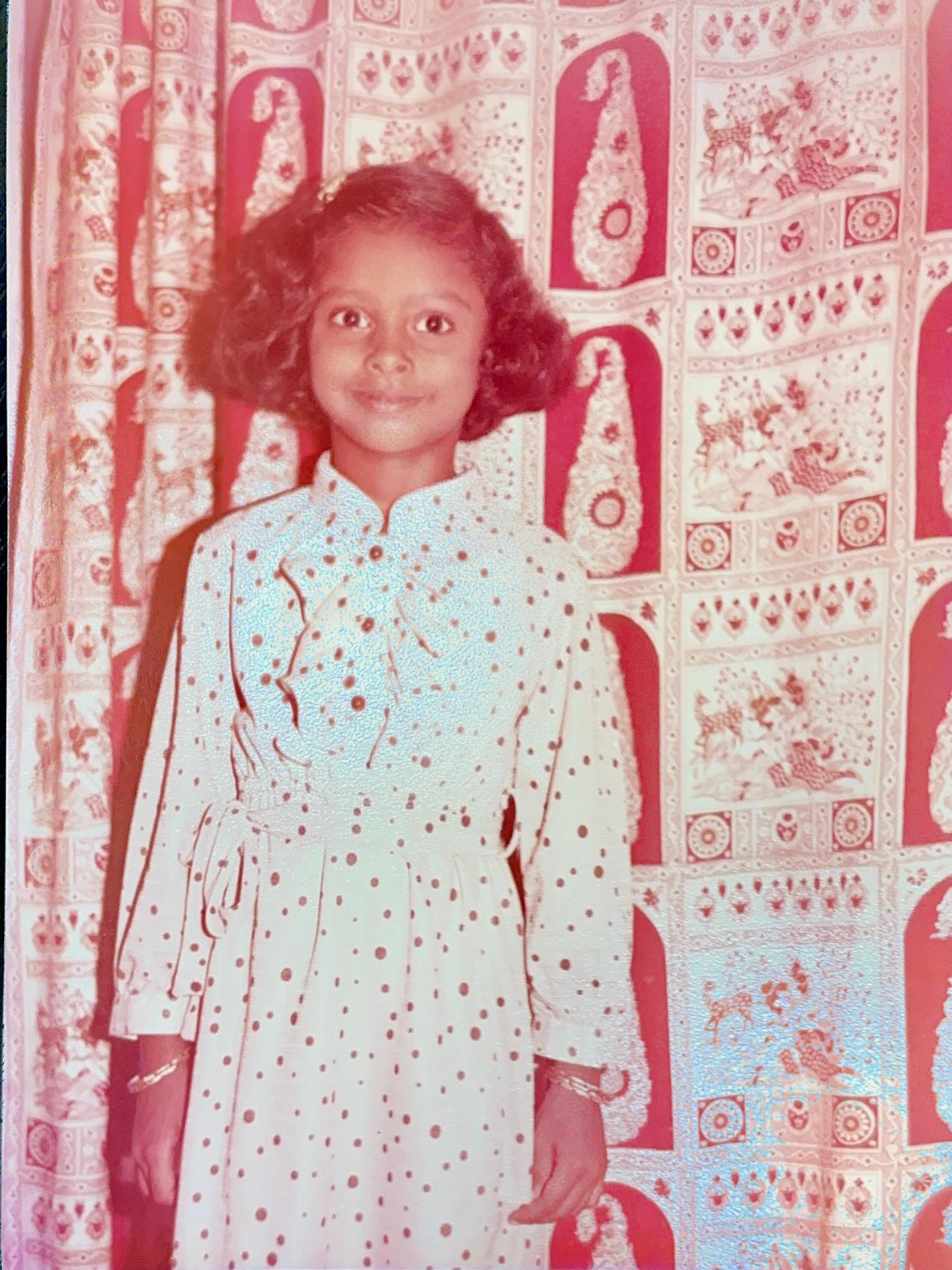
I worked hard not to let my jaw drop at that last one, as the sweet person who said it must have been at least eighty years old. I don’t know much about Mrs. Vance, but she is pretty, so I’ll take the compliment!
Should I have felt slighted by every one of these comments? Should I have walked away from all those relationships? (For the record, all those people are still my friends.) Call me stupid, call me weird, call me too assimilated — I am exhausted of playing the culture wars game & the cultural Christian game ( I know, I know it's not a game, but it’s real and alive).
And that brings me back to my career as a reluctant writer. What should I be writing about? I stopped writing about my marriage. I stopped writing about my Indian American identity. I stopped writing about belonging and community.
I began to write about what deeply matters to me: my faith. I began to write about discipleship, the spiritual disciplines, the practices that draw us closer to God — learning more of His holiness, learning to be still in His presence, learning to surrender and relinquish myself to His will, finding resilience in the desert, sitting with the desert fathers and mothers. I started to write about what it means to live as a follower of Christ in this crazy, gorgeous, and beautiful world.
Despite the pain, the suffering, the political chaos, and all the rest, this is still the world where God has placed me and others like me and unlike me. So I write about that.
But that, too, has been strangely challenging. It’s complicated to pitch ideas like this to publications. It’s hard to get people to read essays on solitude and silence. The stories that get likes and shares are the ones with a hero and a villain. So, I have to remind myself each time that I write when I need to write, and maybe one person will be encouraged, and that is all that matters. A wise man once said, “All of life is a stage,” right?
I find myself in the grey space in the middle. Looking back on this little Substack, nearly all my writing has to do with the in-between — the grey, stuck-in-the-middle space. I’m not entirely sure what to make of that as a writer. It will almost certainly never make me any money. But I hope it encourages the handful of people out there in these interwebs who might feel and think like me.
I have been contemplating a book proposal on assimilation. For the last year or so, I have felt very much like an outsider because of the range of emotions I’ve experienced — and being called “too assimilated” one too many times has gone from funny to making me a little furious. I have had to guard my heart against cynicism and pride, but I am angry. Perhaps that anger will become impetus. I don’t know yet.

For now, though, the writing journey has me stuck. I struggle to express myself and feel lost. My thoughts are like a box of Christmas lights — all twisted and tangled — and finding the space to untangle them and make sense of it all is proving harder than I expected.
What comes next? I’m not sure. So I continue to muse here — or ramble, depending on how you look at it. Maybe, in the midst of all of this, I will find my way.
If you made it this far: thank you. I deeply appreciate each of you who subscribe and are willing to walk with me a little on this journey.
I always appreciate reading your words! I think part of the problem is that writers are encouraged to "niche down," to pick a topic and become known for that topic. But we are complex beings with lots of interests (and many parts to our identity, which I know you understand!) I hope you keep writing about whatever it is that stirs your heart!
Thank you for your heartfelt thoughts about who you are as a writer and what you want to say. You have so much to contribute. Praying that you will sense the Holy Spirit leading you to the message he's given you. I love the analogy of writing as a workout. Most of us are reluctant to go to the gym, but when we do, we almost always leave refreshed. May the Spirit refresh your soul through these words you've shared with us.